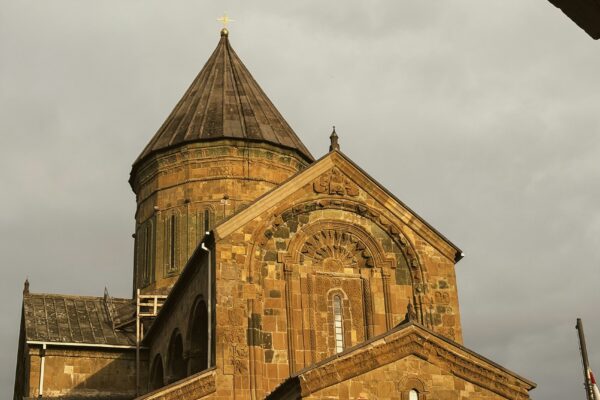
The story of the Georgian Orthodox Church stretches back to the 4th century, when Christianity became the state religion of Iberia (today’s Georgia). Over the following fifteen centuries, hundreds of churches rose across the country, but three cathedrals are repeatedly singled out as the cornerstones of Georgian sacred architecture: the Holy Trinity Cathedral (Sameba) in Tbilisi, the Svetitskhoveli Cathedral in Mtskheta, and the Bagrati Cathedral in Kutaisi. Each is an active house of worship, a masterclass in medieval Georgian building, and — in the cases of Svetitskhoveli and the historic Bagrati inscription — a UNESCO World Heritage Site.

1. Tbilisi — Holy Trinity Cathedral (Tsminda Sameba)
The Holy Trinity Cathedral (წმინდა სამების საკათედრო ტაძარი) sits on the Elia hill in central Tbilisi and serves as the seat of the Georgian Orthodox Church. Its foundation stone was laid on 23 November 1995, and Catholicos-Patriarch Ilia II consecrated the finished building on 23 November 2004, the feast of St. George. The project was conceived in 1989 to mark 1,500 years of Georgian autocephaly and 2,000 years since the birth of Jesus (Source: Wikipedia — Holy Trinity Cathedral of Tbilisi).
Designed by architect Archil Mindiashvili, the cathedral reaches 86.1 m (282 ft) in height, measures 70.4 m long by 64.7 m wide, and covers roughly 3,000 m² of interior space. It is the third-tallest Eastern Orthodox cathedral in the world and one of the largest religious buildings by total area (Source: Wikipedia, Wikidata Q1141688). The plan fuses the medieval Georgian cross-dome typology with subtle Byzantine cues, which critics have described as a synthesis of every major stage of Georgian church architecture.
Entry is free. The cathedral is generally open daily from 09:00 to 22:00 (some sources list 23:00). Modest dress is enforced — women must cover their hair with a scarf or shawl, and bare shoulders or knees are turned away at the door. The complex contains nine chapels and an underground museum of Georgian Orthodox church art and treasury.
2. Mtskheta — Svetitskhoveli Cathedral
About 25 km northwest of Tbilisi lies Mtskheta, the ancient capital of Iberia from the 4th to 5th centuries. In its historic center rises the Svetitskhoveli Cathedral (სვეტიცხოვლი, “the Life-Giving Pillar”), a 57.7 m long, 49 m tall cross-in-square stone building begun in 1010 and completed in 1029 under architect Arsukisdze during the reign of King George I (Source: Wikipedia — Svetitskhoveli Cathedral).
Its holiness rests on a striking legend. In the 1st century, a Georgian Jew from Mtskheta named Elias was in Jerusalem at the Crucifixion; he bought the seamless robe of Jesus from a Roman soldier at Golgotha and brought it home. When his sister Sidonia touched it, she collapsed and died from the overwhelming emotion, and the robe could not be removed from her grip. She was buried with it, and a sacred cedar tree later sprouted over her grave, from which holy myrrh flowed. St. Nino used that oil to baptify King Mirian III and Queen Nana, bringing Christianity to Iberia (Source: Wikipedia — Svetitskhoveli).
In 1994 the cathedral was inscribed as part of the UNESCO World Heritage Site “Historical Monuments of Mtskheta” (criteria iii, iv, reference 708). It has long served as a royal burial place and remains one of the most venerated Orthodox sites in the Caucasus. Admission is 5 GEL for adults (~USD 1.90, free for students) as of June 2026. The exterior arcades and carved decoration are remarkably well preserved for an 11th-century building.
3. Kutaisi — Bagrati Cathedral
On the Ukimerioni Hill overlooking the Rioni River in western Georgia stands the Bagrati Cathedral (ბაგრატი, “Bagrat’s Church”), a purely Georgian-style monument built in the early 11th century under King Bagrat III. An inscription on the north wall places the floor-laying in chronicon 223, i.e. AD 1003, and the church was completed during the first decades of the 11th century (Source: Wikipedia — Bagrati Cathedral).
In 1692 an Ottoman cannonball during the invasion of the Kingdom of Imereti shattered the dome and ceiling, and the cathedral lay in ruins for centuries. Restoration began in the 1950s under Georgian architect Vakhtang Tsintsadze and continued in six phases through 1994. That year, Bagrati Cathedral, together with the nearby Gelati Monastery, was inscribed as a UNESCO World Heritage Site (reference 710). However, controversy over the conservation approach led UNESCO to add the site to its endangered list in 2010, and the cathedral was eventually delisted in 2017. The English architectural historian William Lethaby nevertheless called it “the finest of Georgian monuments.”
Today the cathedral belongs to the Georgian Orthodox Church and serves as the seat of the Metropolitan of Kutaisi. Local couples frequently choose it for weddings. Entry is free, and a 20-minute walk from the city center takes you to the top of the Ukimerioni hill, where you can take in the Rioni valley and the Kutaisi skyline in a single sweep.
How to visit all three in one trip
Although each cathedral sits in a different city, Tbilisi, Mtskheta and Kutaisi are linked by a single road corridor (S1 → S12), so a comfortable two-day itinerary covers all three.
- Day 1 morning: Leave Tbilisi west on the S1 highway (30–40 min by car or marshrutka) to Mtskheta. Tour Svetitskhoveli and the Mtskheta museum.
- Day 1 afternoon: Return to Tbilisi. After work, walk up to the Holy Trinity Cathedral for a tour of the interior and the panoramic night view over the city.
- Day 2: From Tbilisi take the S12 westbound for 230 km to Kutaisi (4–5 hours by marshrutka or train). Add the Gelati Monastery, about 12 km northeast of the city, to round out the day.
Strict dress codes apply at all three sites — bring clothing that covers shoulders and knees, and women should carry a scarf for head-coverings. The most cost-effective intercity transport is a marshrutka from Tbilisi’s central Ortachala bus station: about 25 GEL to Kutaisi (~USD 9.40) and just 2 GEL to Mtskheta (~USD 0.75) as of June 2026 (Source: Georgia.travel, on-site checks). Exchange rates used here: 1 USD ≈ 2.65 GEL, 1 GEL ≈ 570 KRW (Source: Wise, Trading Economics, June 2026).
To dig deeper into the history and architecture of these three cathedrals, start with the official UNESCO listing for the Historical Monuments of Mtskheta and our companion piece on walking Rustaveli Avenue. → Plan your cathedral tour