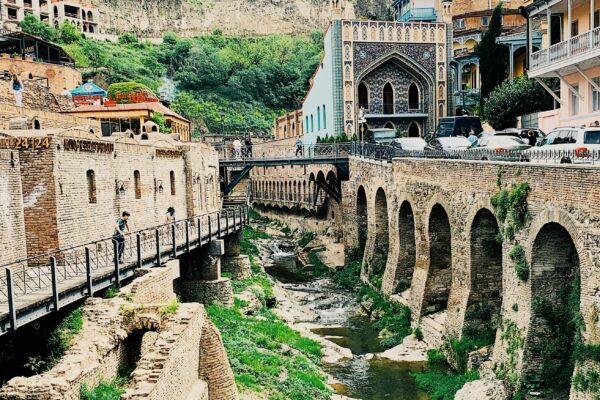
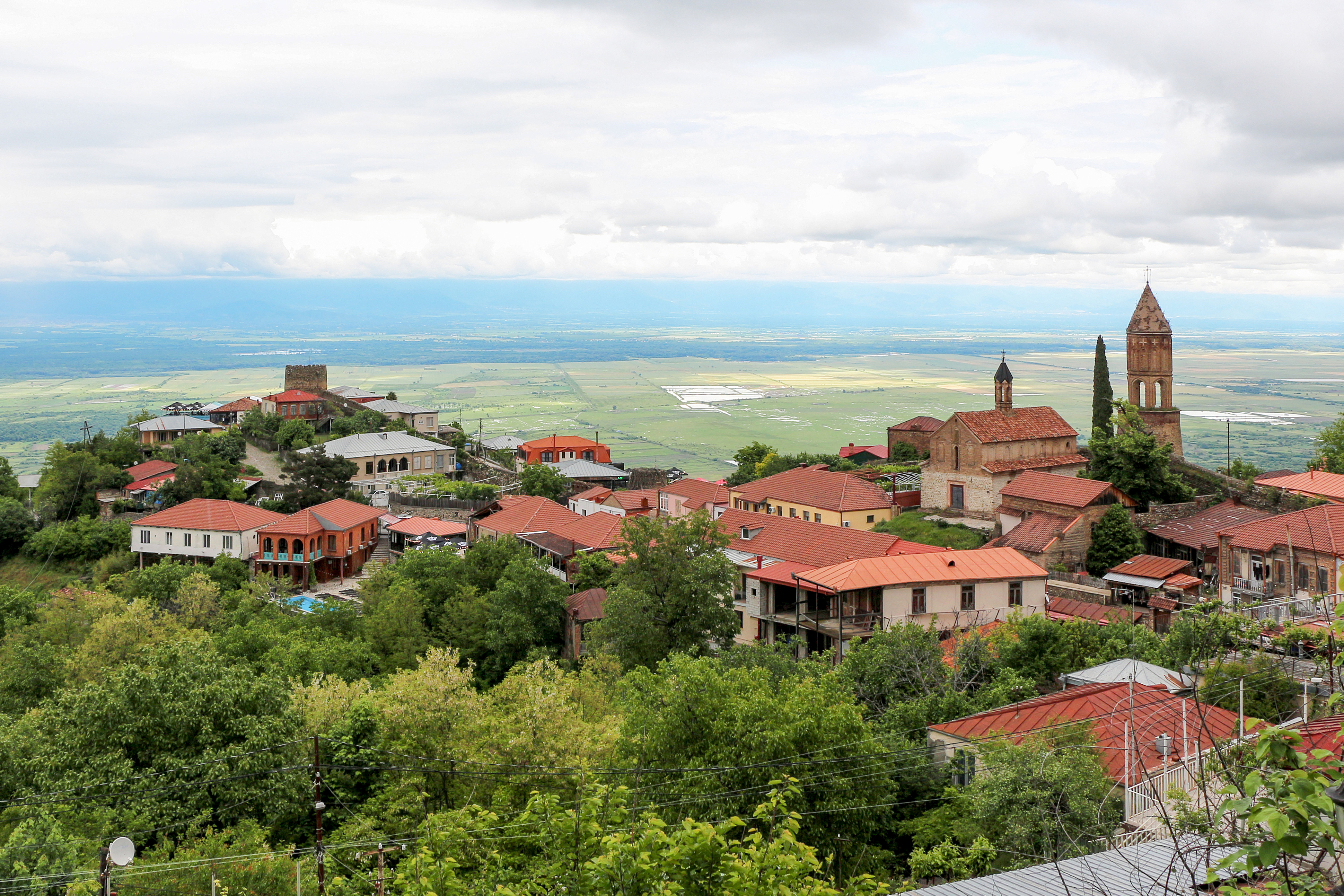
Perched on a ridge above the Alazani Valley in Georgia’s Kakheti region, Sighnaghi (სიღნაღი) is a tiny hilltop town roughly 110km — about 1 hour 30 minutes by car — east of Tbilisi. Sitting at around 800 meters of elevation, the town is encircled by an 18th-century defensive wall and is widely nicknamed the City of Love, a label popularized by the local poet Babuna Tsivtsivadze. Its red-brick ramparts, 23 towers, sweeping views of the Caucasus foothills, and a 24-hour marriage registry make it one of the most popular day-trip and honeymoon stops from the capital.
1. A Brief History — King Erekle II and the 5km Wall
Sighnaghi’s documented history reaches back to the 18th century. In 1762, King Heraclius II (Erekle II) unified the Kingdom of Kakheti and ordered the village’s transformation into a heavily fortified town to defend against repeated Persian and Ottoman incursions. The defensive walls were completed during the 1770s; they stretch for approximately 5 kilometers and incorporate 23 watchtowers, with the tallest sections rising about 7 meters and reaching 1.5 meters thick (Source: Wikipedia — Sighnaghi; Georgian National Agency for Cultural Heritage Registry).
After Georgia was annexed by the Russian Empire in 1801, the fortifications lost their military purpose. The town shrank dramatically during the 1990s civil conflict and subsequent emigration wave; today the resident population stands at roughly 2,100 people (Source: GeoStat, 2024). Beginning in the early 2000s, the entire Old Town was restored — red brickwork, carved wooden balconies, and tiled gable roofs — turning Sighnaghi into an open-air museum of Kakhetian architecture, lined with small boutique hotels, family-run wineries, and craft shops.
The romantic epithet “City of Love” traces to a 19th-century Kakhetian folk song in which Tsivtsivadze wrote that “a couple married here will love each other forever.” The nickname stuck, and the local government capitalized on it by opening a 24-hour Marriage Palace in the town center — an unusually practical amenity for a settlement of just two thousand residents.
2. Walking the Wall — Best Viewpoints
The highlight of any Sighnaghi visit is the town wall circuit. Access is free from any of the several staircases in the Old Town. The walkway is 1.5 to 2 meters wide and runs roughly 5 kilometers end-to-end; allow 1.5 to 2 hours at a leisurely pace. From the top, the view opens across the Alazani Valley, with the Greater Caucasus ridge on the horizon — on clear days, you can see snow-capped peaks well into Azerbaijan.
- Viewpoint ① (South end): the cliff-edge bastion overlooking the entire Alazani plain. The 30 minutes before sunset are the most photographed window of the day.
- Viewpoint ② (Center): the bell tower of St. George’s Church, framed by traditional Kakhetian houses with carved wooden balconies.
- Viewpoint ③ (Town hall area): the Marriage Palace, a 1960s modernist building set against the medieval ramparts — a uniquely Georgian architectural juxtaposition.
Wall access is free at all hours. Night illumination typically runs from dusk until about 21:30 (summer, June 2026), making the post-sunset walk one of the most atmospheric experiences in eastern Georgia. Note that the official sunset in late June is around 20:30, so plan to be on the wall by 20:00 to catch both golden hour and the lighting transition.
3. Wine and Food — The Taste of Kakheti
Sighnaghi is the heart of Kakheti, Georgia’s flagship wine region and arguably the oldest continuously cultivated wine region on earth: 8,000-year-old qvevri clay vessels were unearthed nearby. Inside and just outside the Old Town, around 30 family-run wineries — many of them called marneuli or qvevri wineries — offer tastings. As of June 2026, tasting packages typically run between 10 and 20 GEL (approximately USD 3.8–7.5 or KRW 5,700–11,400) per person.
- Saperavi: Georgia’s signature black grape. Deep ruby color, firm tannins, and dark-berry aromas — ideal with grilled meat.
- Mtsvane: Kakheti’s principal white grape. Light-bodied and high-acid, pairs naturally with khachapuri and sulguni cheese.
- Kindzmarauli: a naturally semi-sweet red made from Saperavi; the most approachable choice for visitors new to Georgian wine.
The must-try dish in Sighnaghi is Kakhetian khachapuri — not the Adjarian boat-shaped version familiar abroad, but a round flatbread topped with two kinds of cheese and a generous slab of butter, eaten by tearing off pieces and dipping. A full pie runs 12–18 GEL (KRW 6,800–10,300), enough for two or three people to share. Two restaurants widely recommended by both locals and repeat visitors are Likoq’a and Okiure, both within walking distance of the central square.
4. Getting Married at the Marriage Palace
Sighnaghi’s quirky claim to fame among international travelers is its 24-hour Marriage Palace (ქორწინების სასახლე). Standard office hours are Monday–Friday 09:00–18:00 and weekends 10:00–16:00, but pre-booked ceremonies can be arranged at virtually any hour, including the small hours of the morning. For foreign couples, the standard paperwork is a marriage-ability certificate, passport copies, and a notarized Georgian translation; the entire process takes about 30 minutes once the documents are in order.
The base registration fee is 100 GEL (approximately USD 38 or KRW 57,000 as of June 2026), with an additional 10 GEL per witness (Source: Public Service Hall Georgia, June 2026). The marriage certificate is issued in Georgian and English. Registering the marriage with Korean civil authorities afterwards requires consular authentication — note that Georgia has no Korean embassy or consulate, so Korean couples must route documents through the Korean consulate in Frankfurt, Germany, or the embassy in Moscow. Plan for at least two months of buffer time before departure (Source: Korean Ministry of Foreign Affairs consular guidance).
5. Getting There from Tbilisi
Three practical options connect Sighnaghi to the Georgian capital. All distances and times below are measured from central Tbilisi (Rustaveli Avenue) and verified as of June 2026.
| Transport | Travel time | Cost | Notes |
|---|---|---|---|
| Rental car (self-drive) | ~1h 30min | 80–120 GEL/day (KRW 45,600–68,400) | S5 highway via Alazani Valley |
| Organized day tour | ~10–12 hours | 80–120 GEL/person (KRW 45,600–68,400) | Tbilisi pickup, lunch usually included |
| Marshrutka (minibus) | ~2 hours | 8 GEL one-way (KRW 4,560) | From Isani bus terminal; irregular schedule |
The best value for first-time visitors is an organized day tour with a Korean-speaking guide, which typically runs 100–150 GEL per person (KRW 57,000–85,500, USD 38–57). Combining Sighnaghi with a Telavi or Gremi winery stop is the standard full-day Kakheti itinerary. The marshrutka is the cheapest option but operates on a rough, Russian-language schedule and is less suited for solo travelers without local contacts.
For currency context, 1 USD ≈ 2.65 GEL and 1 GEL ≈ 570 KRW as of June 2026 (Source: Wise and Trading Economics). English is widely spoken in Sighnaghi’s tourist-facing businesses, but Korean-language signage is essentially nonexistent throughout Kakheti — learning two or three basic Russian phrases (such as spasibo for “thank you”) goes a long way.
Sighnaghi at a Glance
| Item | Detail | Source |
|---|---|---|
| Distance from Tbilisi | ~110km, 1h 30min | S5 highway via Alazani Valley |
| Elevation | ~800m | Wikipedia — Sighnaghi |
| Population | ~2,100 | GeoStat 2024 |
| Wall circuit length | ~5km, 23 towers | Georgian Cultural Heritage Registry |
| Wall access | Free | Night lighting to ~21:30 |
| Marriage registration | 100 GEL (~KRW 57,000) | Public Service Hall Georgia |
| Recommended stay | 4–6 hours (day trip) | Overnight ideal for wine tours |
Sighnaghi is the most concentrated introduction to Kakheti that a visitor can find within easy striking distance of Tbilisi. Walk the red walls, look out over the Alazani Valley, finish with a glass of Saperavi, and you have covered the essentials of eastern Georgia in a single day. For deeper routes into the region, see our Guardians of Georgian Wine feature and the official Sighnaghi Municipality website.
→ Book your free Sighnaghi itinerary consultation (Korean-speaking guide included)