Tucked between the Black Sea and the Caspian, Georgia (საქართველო) holds just four UNESCO World Heritage Sites as of June 2026 — three cultural, one natural. That number may sound small for a country of 3.7 million people and 69,700 km², but on a per-area basis it places Georgia among the densest heritage holders on Earth. Each site opens a different era in one trip: the early Christian world at Mtskheta (inscribed 1994), the medieval Georgian kingdom at Bagrati and Gelati (1994), the indigenous Caucasian highland at Upper Svaneti (1996), and the post-glacial temperate forest at the Colchic Forests and Wetlands (2021) (Source: UNESCO World Heritage Centre — Georgia page, accessed June 2026).
1. Historical Monuments of Mtskheta (Inscribed 1994)
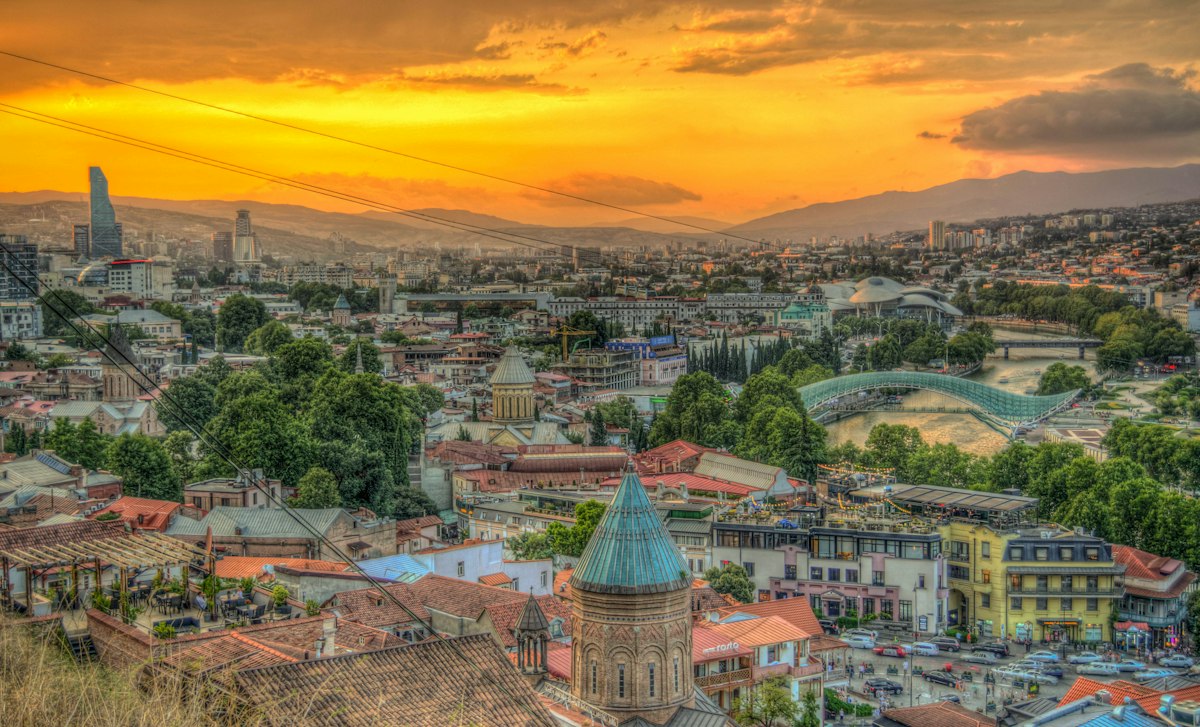
Twenty-five kilometres northwest of Tbilisi, at the confluence of the Mtkvari (Kura) and Aragvi rivers, sits Mtskheta — capital of the Iberian Kingdom from the 3rd century BC until the 5th century AD. In AD 337, King Mirian III adopted Christianity here, making Georgia the world’s second state to do so. UNESCO inscribed the Mtskheta ensemble in 1994 under four of the eleven criteria at once: (i), (iii), (iv), and (vi).
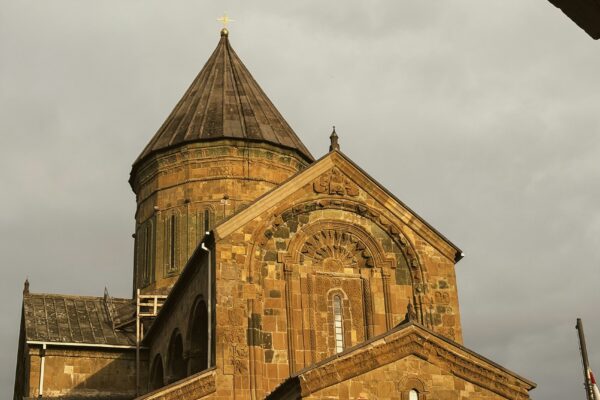
Two monuments anchor the site. The 6th-century Jvari Monastery (ჯვარი) is the prototype of Caucasian Orthodox cross-dome architecture, immortalised in Shota Rustaveli’s 12th-century epic The Knight in the Panther’s Skin. A 20-minute walk away rises the 11th-century Svetitskhoveli Cathedral (სვეტიცხოველი), 49 m tall and 30 m long, whose interior pillars depict the legend of St. Sidonia. Its ground-floor ambulatory is still used for outdoor preaching (Source: Wikimedia — Svetitskhoveli Cathedral, accessed June 2026).
A guided visit takes 2–3 hours. As of June 2026, the entry fee is 15 GEL per adult (about USD 5.7 / KRW 8,600), 5 GEL for students. Day-tour packages from Tbilisi run 80–120 GEL per person (USD 30–45) including hotel pickup (Source: SmartWanderer and Tbilisi Free Walking Tours, June 2026).
2. Bagrati Cathedral and Gelati Monastery (Inscribed 1994)
Western Georgia’s Imereti region carries the legacy of Georgia’s 11th–12th-century golden age. Bagrati Cathedral (ბაგრატი), completed in 1003 by King Bagrat III, is a nine-bay structure with a 39.3 m dome. Ottoman artillery heavily damaged it in the 17th century, and a long restoration ended in 2012. The cathedral is 38.7 m long and remains a panoramic landmark above Kutaisi (Source: Wikipedia — Bagrati Cathedral, accessed June 2026).
Twelve kilometres uphill stands the Gelati Monastery (გელათი), founded in 1106 by King David the Builder as a centre of theology, philosophy, and natural science. Above its main gate runs a trilingual inscription in Georgian, Greek, and Hebrew: “Peace to those who enter here.” The royal chapel measures 35.4 m by 30 m, with original 12th-century mosaic frescoes. The attached library, with 5,000+ manuscripts from the 12th to 17th centuries, is partly on display in a museum that opened in 2023 (Source: Georgian National Museum — Gelati Academy, June 2026).
Combined entry is 14 GEL (about USD 5.3 / KRW 8,000). Kutaisi is 1 h 30 min by marshrutka from Tbilisi at 10 GEL one way (Source: Georgian Railway timetable, June 2026).
3. Upper Svaneti (Inscribed 1996)
South of Mount Shkhara (5,193 m), the highest peak in the Greater Caucasus, the Mestia and Ushguli valleys were inscribed in 1996 under criteria (iii), (iv), and (v). The signature element is the Svan tower (სვანური ციხე): more than 200 stone defensive towers built between the 9th and 13th centuries, each 4–5 storeys tall with double or triple oak doors. They served as clan-level fortresses during a long era of local autonomy (Source: UNESCO — Upper Svaneti, June 2026).
Ushguli, sitting at 2,100 m, is one of Europe’s highest continuously inhabited villages. The 9th-century Lamaria Church (ლამარია) and the tower complex of Shkhara (შუკარი) are the highlights. Buried in Lamaria’s sealed west wing, the Svaneti Manuscripts — a palimpsest of 1,000+ pages dating from the 5th to 11th centuries — were added to UNESCO’s Memory of the World register in 2020 (Source: UNESCO Memory of the World — Georgian Manuscripts, June 2026).
From Tbilisi, marshrutka to Mestia takes about 9 hours and costs 40 GEL one way (USD 15). The faster option is a 1 h 5 min flight to Zugdidi (90–150 GEL each way, USD 34–57) followed by a 2 h 30 min 4WD transfer. A guided 3-day Svaneti tour with 4WD and two nights’ lodging runs 450–650 GEL per person (USD 170–245) (Source: Visit Svaneti — official guide, June 2026).
4. Colchic Forests and Wetlands (Inscribed 2021)
Georgia’s only natural site, Colchic Forests and Wetlands (კოლხეთის ტყეები), was added at the 44th session of the World Heritage Committee in Fuzhou, China, in 2021. The serial property covers 76,210 ha across six protected areas along the Black Sea coast: Kolkheti National Park, Lake Kitria, Imereti Caves, Grigoleti Wetland, Mtirala National Park, and Chachava Lake. It shelters temperate broadleaf forest that has survived in place for 2.5 million years — a refuge untouched by the Pleistocene ice sheets (Source: UNESCO WHC — Colchic Forests and Wetlands decision, June 2026).
Key species include Colchic oak (Quercus colchica), Colchic boxwood (Buxus colchica), and the Caucasian snow rhododendron (Rhododendron ungernii). Mammals present are grey wolf, Eurasian lynx, and Caucasian jungle cat. The wetland is also a stopover for more than 1% of the global population of red-breasted goose (Branta ruficollis) on the East Atlantic flyway (Source: BirdLife International — Important Bird Areas, June 2026).
Entry to Kolkheti National Park is 10 GEL (USD 3.8). A specialist guide costs 80–120 GEL per day (USD 30–45). A 2 h 30 min boat tour from Poti is 60 GEL (USD 23) (Source: Agency of Protected Areas of Georgia — 2026 fee schedule).
5. A 14-Day Route to Cover All Four Sites
The four sites sit in three corners of the country: Colchic Forests in the west, Mtskheta/Bagrati/Gelati in the centre, and Upper Svaneti in the north. A realistic Tbilisi-based 14-day loop (as of June 2026, official UNESCO Georgia list) looks like this: For an Mtskheta day trip map and the latest trail closures, see the Georgian National Tourism Administration site.
| Day | Route | UNESCO Site | Transport |
|---|---|---|---|
| 1–2 | Arrive Tbilisi, city settling-in | — | — |
| 3 | Tbilisi → Mtskheta → Tbilisi | Historical Monuments of Mtskheta | Marshrutka 2 GEL each way |
| 4–5 | Tbilisi → Kutaisi → Tbilisi | Bagrati + Gelati | Train 8 GEL each way |
| 6–8 | Tbilisi → Mestia → Ushguli | Upper Svaneti | Flight 90–150 GEL |
| 9–10 | Mestia → Tbilisi | — | Flight 90–150 GEL |
| 11–12 | Tbilisi → Batumi → Poti | — | Train 20 GEL each way |
| 13–14 | Poti → Kolkheti NP → Tbilisi | Colchic Forests and Wetlands | Boat tour 60 GEL |
Exchange rates applied: 1 USD ≈ 2.65 GEL, 1 GEL ≈ 577 KRW (Source: Wise and Trading Economics, June 2026). The full 14-day per-person budget including transport, lodging, and entrance fees lands at 1,200–1,800 GEL (USD 450–680 / KRW 684,000–1,026,000), roughly 30–40% below Western European averages.
Quick Reference — Georgia’s Four UNESCO Sites
| Site | Inscribed | Type | Entry Fee (Jun 2026) | Best Season |
|---|---|---|---|---|
| Historical Monuments of Mtskheta | 1994 | Cultural | 15 GEL | Apr–Jun, Sep–Oct |
| Bagrati + Gelati | 1994 | Cultural | 14 GEL (combined) | May–Jun, Sep |
| Upper Svaneti | 1996 | Cultural | 0 GEL (free village access) | Jun–Sep |
| Colchic Forests and Wetlands | 2021 | Natural | 10 GEL | May–Jun, Sep–Oct |
Small country, four heritages, four different centuries. From the 4th-century cradle of Orthodox Christianity at Mtskheta to the 2.5-million-year-old Colchic forest, Georgia packs more historical depth per kilometre than almost anywhere in Europe. First-time visitors can grasp one full era by exploring even a single site — the Mtskheta ensemble is the easiest day trip from Tbilisi and a strong recommendation for a first stop.
For a custom 14-day itinerary, Korean-language guide matching, or a vehicle + driver bundle for Svaneti and Kolkheti, the Georgia Travel Blog “Travel Enquiry” page offers a free 1:1 consultation with a Korean-speaking coordinator. Pre-booking a 4WD and guide is strongly recommended for Svaneti and the Colchic wetlands, where public transport is sparse.