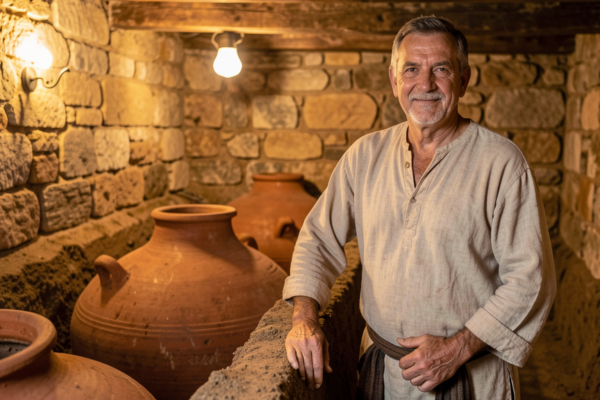
When the story of Georgian wine is told, the grape and the fermentation take centre stage — yet something else matters just as much: the vessel that holds the wine. That vessel is the qvevri, an egg-shaped clay amphora buried underground and used for winemaking in the Caucasus since the 6th millennium BC (Source: Wikipedia, Kvevri). But a qvevri is not a factory product. Each one is built by a single craftsman over several months, tended through a week of sleepless nights beside a kiln, and only then ready to hold wine. This guide follows how a qvevri is made and introduces the artisans — above all the Kbilashvili family of Kakheti — who keep this four-generation tradition alive.

1. What Is a Qvevri?
A qvevri is a handleless, egg-shaped earthenware vessel used for fermentation, ageing and storage in traditional Georgian winemaking. They range from small 20-litre pots to giants of 10,000 litres, with roughly 800 litres being the typical size (Source: Wikipedia). The decisive feature is that the whole vessel is buried in the ground: the surrounding earth acts as a natural insulator, keeping fermentation temperatures stable year-round. Georgia inscribed the qvevri method on its national Intangible Cultural Heritage register in 2011, and in 2013 UNESCO added it to the Representative List of the Intangible Cultural Heritage of Humanity (element 00870) (Source: UNESCO).
2. From Clay to Amphora: How a Qvevri Is Made
A single qvevri takes several months to complete (Source: Saperavi Brothers). The work falls into roughly four stages.
- (1) Sourcing the clay. Each maker has their own favoured local clay spot. Because the clay’s mineral content affects the wine’s mineral profile, choosing the earth is already part of shaping the flavour (Source: Wikipedia).
- (2) Shaping. The vessel is built up layer by layer by hand into its egg form, traditionally without a wheel — clay coils stacked and smoothed.
- (3) Firing. The finished pot is placed in a kiln and fired for about a week. Someone must stay beside the kiln twenty-four hours a day, feeding wood to hold a constant heat. During firing the vessel changes colour several times, and the master judges the right moment by that colour combined with a distinctive ring or “singing” sound the clay makes (Source: Around the World in 80 Harvests).
- (4) Finishing — beeswax and limestone. Once cooled, the inside is lined with beeswax to sterilise and waterproof it, while the outside is coated with limestone to protect it from earthquakes and the moisture of the earth it will be buried in (Source: Around the World in 80 Harvests).

3. The Keepers of the Tradition: Zaza Kbilashvili and Vardisubani
About three kilometres from Telavi, the cultural capital of the Kakheti wine region, lies the village of Vardisubani, home to a family famous for qvevri-making. Zaza Kbilashvili is a fourth-generation qvevri master who took over the craft from his father Remi (Source: Saperavi Brothers; Source: Georgian Holidays). Zaza admits he once hesitated about continuing the family legacy, but today he is one of its most determined defenders — actively teaching younger Georgians the craft so it does not die with his generation. Demand has grown so much that his waiting list for orders “gets longer by the day,” and buyers can wait a long time before a vessel is ready (Source: Saperavi Brothers).
Vardisubani is not alone. According to Wikipedia, the traditional qvevri-making villages of Georgia include Atsana in Guria; Makatubani, Shrosha, Tq’emlovana and Chkhiroula in Imereti; and Vardisubani in Kakheti (Source: Wikipedia). The deeper concern is the shrinking number of makers. By expert estimate there are now fewer than a dozen active qvevri masters in all of Georgia (Source: Around the World in 80 Harvests). The work — stacking clay by hand and keeping vigil by a kiln for a week — is hard, and few young people are willing to take it on.
4. Price and Value: Made Once, Used for Centuries
A qvevri is expensive, but it lasts. In 2026 a roughly 2,000-litre vessel costs about USD 2,000 (around 5,340 GEL) (Source: Around the World in 80 Harvests; cross-check: Domaine Georgia notes qvevri run roughly 60% cheaper than French oak barrels). A well-made qvevri can be used for centuries, which makes it economical in the long run — though each year, after harvest, someone must physically climb inside the vessel to clean it and re-apply the beeswax and limestone lining.
At the June 2026 exchange rate of roughly 1 GEL ≈ 0.37 USD (about 577 KRW) (Source: live exchange rate, 2026-06-21), a 2,000-litre qvevri works out to about USD 2,000 / KRW 3.08 million. Prices are approximate figures from local makers and may vary.

5. Visiting a Qvevri Workshop: Kakheti Travel Tips
To watch a qvevri master at work, build Vardisubani into a Kakheti itinerary. Its proximity to Telavi makes it easy to combine with Sighnaghi, Gudauri or a Tbilisi day trip.
- Where: the Kbilashvili family workshop in Vardisubani, near Telavi. Visits can be arranged through local wine-tour operators (Source: Georgian Holidays, Kbilashvili Winery).
- What you’ll see: the history of the qvevri, a demonstration of the traditional shaping and firing process (if you’re lucky, the final stage of lighting the kiln), and a tasting of amber wine fermented and aged in qvevri.
- When: autumn harvest (September–October) and spring (April–June) are best for seeing vineyards and active winemaking together. Winter (December–February) is the makers’ production season, so it is the best time to watch vessels being built.
- Combine with: the Alaverdi Monastery and vineyards near Telavi, the Sighnaghi wine museum, and a qvevri-wine tasting at a nearby family winery — all can be woven into a single route.

6. Travel Tips: Budget and Etiquette
- Budget guide: a qvevri-workshop visit with tasting usually runs a few dozen GEL per person, while a family-winery dinner-plus-tasting package is around 80–150 GEL per person (Source: local tour prices, 2026). A private guided day tour linking Telavi and Sighnaghi is roughly 200–350 GEL per person. At 1 GEL ≈ USD 0.37, that works out to about USD 75–130 (roughly KRW 110,000–200,000) per person for a full day (Source: live exchange rate, 2026-06-21).
- Booking: workshops are small family operations, so advance booking is essential. In peak season (autumn harvest) reserve two to three weeks ahead.
- Etiquette: a qvevri is a working vessel, not a museum piece. Always ask the master’s permission before touching anything or approaching the kiln. When offered a toast (“Gaumarjos!”), clink glasses and join in — this is central to Georgian hospitality.
- Souvenirs: large qvevri are impossible to carry home, but small tabletop qvevri replicas and clay cups make fine keepsakes. A bottle of qvevri-made amber wine travels well and is a wonderful memento.
Final tip: a single sip of Georgian wine in your glass already holds a much longer story of clay, fire and time. Without the hands of a master who tends a kiln for a week in a quiet Kakheti village, that taste would not exist. On your next trip to Georgia, meet not only the wine but the vessel — and the people who make it. If you would like a qvevri-workshop route and tasting itinerary, see the guide below.
🏺 See the qvevri-workshop route and ask about bookings →
Sources: UNESCO Representative List of the Intangible Cultural Heritage of Humanity (element 00870; inscribed 2013, national register 2011); Wikipedia, Kvevri; National Wine Agency of Georgia (wine.gov.ge); Saperavi Brothers; Around the World in 80 Harvests; Georgian Holidays. Exchange rate from a live query (2026-06-21); prices are approximate figures from local makers and tour operators and may differ in practice.